Intelligent systems
for acute
stroke care.

The evidence is settled. The delivery is broken. Across a fragmented pathway, the right decision is lost at every handoff. HORUS is the intelligence layer that closes those gaps, so every patient gets the right treatment, in real time.

University of Pittsburgh A University of Pittsburgh–licensed company

HORUS NeuroTechnologies

A clinical intelligence company for acute stroke.

HORUS NeuroTechnologies is a University of Pittsburgh–licensed company building the intelligence layer for acute ischemic stroke care. Our systems read the clinical picture in real time and return guideline-graded, personalized decisions at the moment they matter most.

Founded by a vascular and interventional neurology team, and researchers who know code strokes to the core, HORUS turns the evidence the field already has into decisions that reach every patient, at every center, every time.

Real timeAnswers inside the treatment window, not after it.
Guideline-gradedEvery recommendation carries its Class and level of evidence.
PersonalizedTuned to the patient in front of you, not the average.

The problem

Evidence exists. Delivery fails.

01

The burden is growing

Stroke volume keeps climbing while the window to act stays measured in minutes.

02

The system is fragmented

Hub-and-spoke transfers split the decision across sites, teams, and shift changes.

03

Human cognition has limits

The guideline runs to dozens of branching rules. No one recalls all of them under a running clock.

04

The liability is severe

A missed indication is an unforgiven mistake, clinically and for the people who carry it.

One pathway, broken at every handoff.
Prehospital Miscommunication Jupiter
Imaging Data gaps Sapiens Suite
Decision Cognitive overload LUCID
Trials Missed enrollment TrialLens
Records Lost follow-up Concordia, Janus
Quality & billing Uncoordinated CalliSync, ActusBill, Custos

Today the pathway breaks at every handoff. Each red mark is a point where the right decision can slip.

The human cost

Screaming in silence.

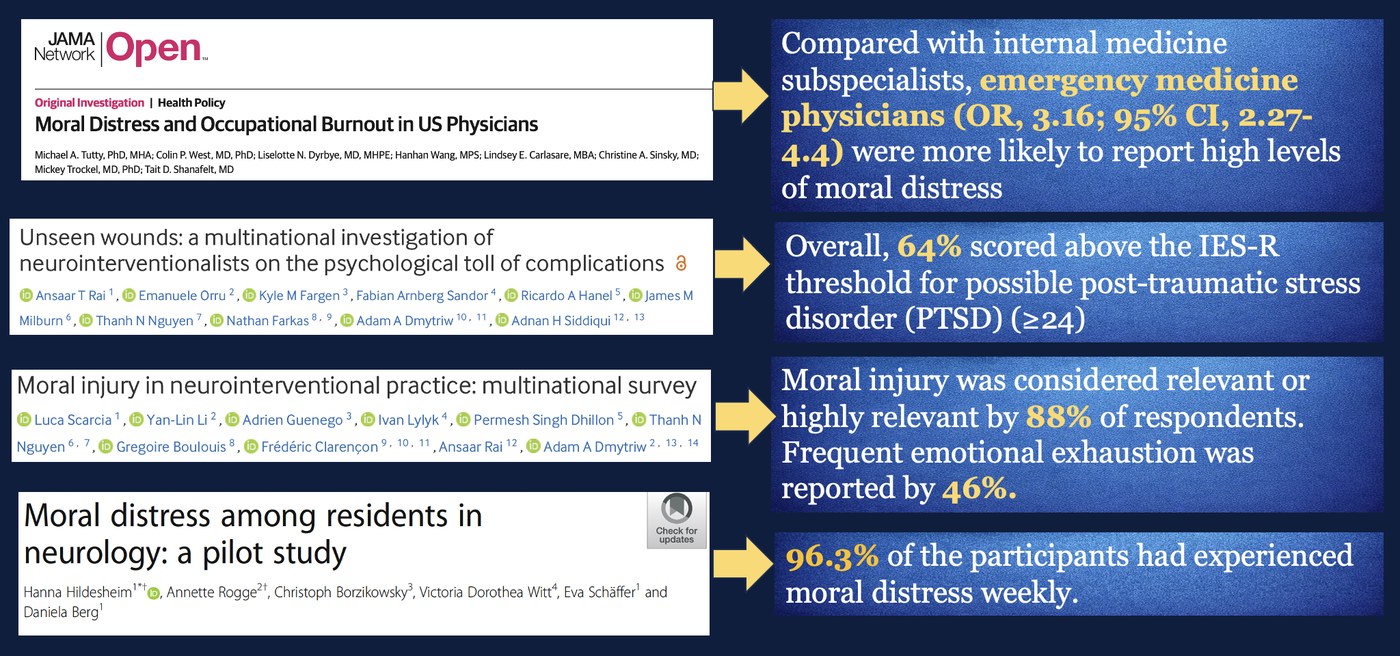
The clinicians carrying these decisions are paying for the gaps. The evidence is quiet, peer-reviewed, and hard to unsee.

0%
of neurology residents surveyed had experienced moral distress weekly
Hildesheim et al. · neurology-resident pilot study
0%
of neurointerventionalists considered moral injury relevant or highly relevant
Scarcia et al. · neurointerventional moral-injury survey
0%
scored above the IES-R threshold for possible PTSD
Rai et al. · “Unseen wounds”
OR 0
higher odds of high moral distress for emergency physicians vs. IM subspecialists
Tutty et al. · JAMA Network Open
See the source excerptsHide source excerpts
Peer-reviewed evidence: JAMA Network Open on moral distress and burnout in US physicians (emergency physicians OR 3.16); a multinational study finding 64% of neurointerventionalists above the IES-R PTSD threshold; a survey finding moral injury relevant to 88% and emotional exhaustion in 46%; and a neurology-resident pilot finding 96.3% experienced moral distress weekly.

A day in acute stroke

A notification is how the cycle begins.

13:47 on a Wednesday. It starts calm. Then a transfer comes in and the questions arrive faster than anyone can answer them. Here is that hour, from the quiet before to the outcome the next day.

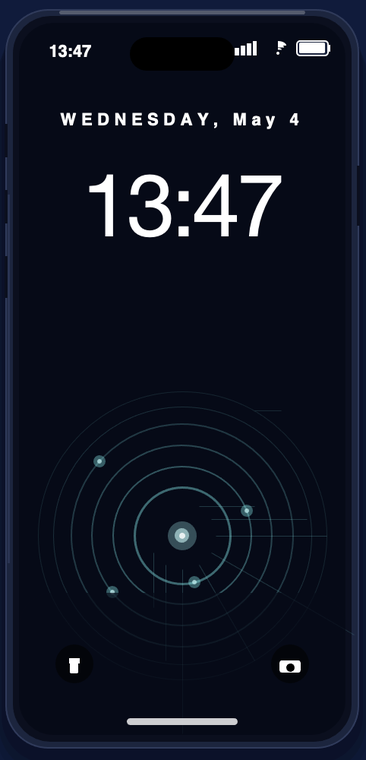
Phone lock screen at 13:47 on Wednesday, May 4, calm, before any alert has arrived.
13:47 · the clock is not yet running

The calm before.

An ordinary Wednesday afternoon. In a moment, a transfer somewhere will set the clock running, and this quiet screen will light up.

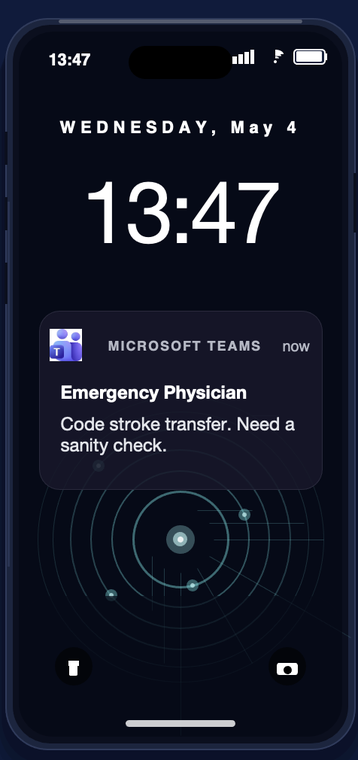
Phone lock screen at 13:47: Microsoft Teams notification from an Emergency Physician reading 'Code stroke transfer. Need a sanity check.'
13:47 · the ping

The clock starts.

A code-stroke transfer lands as a notification. The clock is already running before anyone has opened a chart.

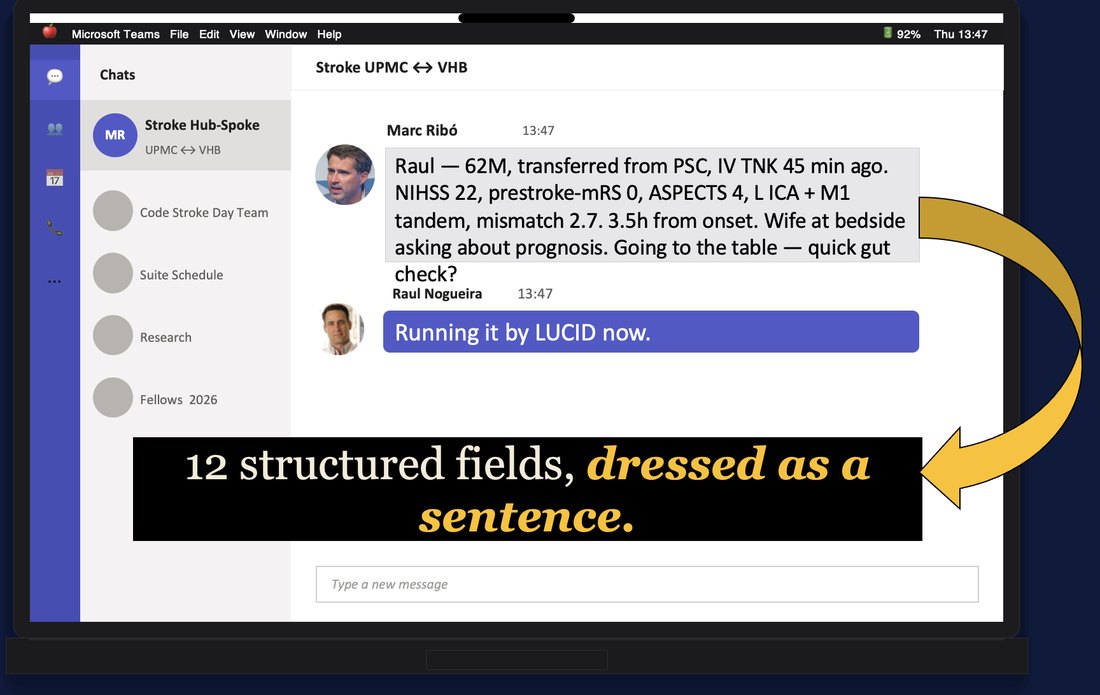
Microsoft Teams: a dense transfer handoff message with twelve clinical fields packed into a single sentence, and the reply 'Running it by LUCID now.'
13:47 · the handoff

Twelve structured fields, dressed as a sentence.

Age, thrombolytic timing, NIHSS, pre-stroke mRS, ASPECTS, vessel, mismatch, time from onset — all arriving as one breathless line. The reply: running it by LUCID now.

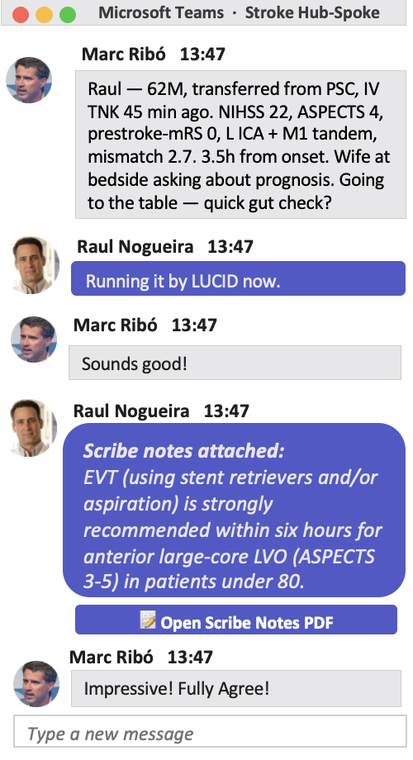
Teams thread: LUCID returns scribe notes recommending endovascular thrombectomy within six hours for anterior large-core LVO, with an Open Scribe Notes PDF button.
under 5 seconds · the answer

A graded answer, and the note.

LUCID returns the recommendation, graded by Class and level of evidence, with the scribe note already written and attached as a PDF.

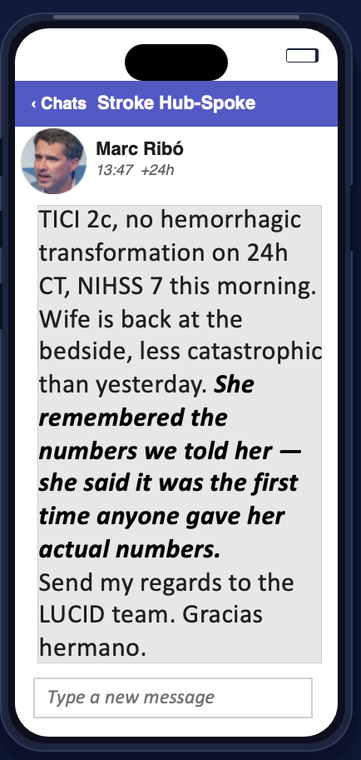
Phone, +24 hours: TICI 2c, no hemorrhagic transformation, NIHSS 7. 'She said it was the first time anyone gave her actual numbers.'
+24 hours · the outcome

The next morning.

TICI 2c, NIHSS 7, no hemorrhage. The family remembered the numbers, because for once someone gave them actual numbers.

The ecosystem

Smart systems. One care pathway.

Two products are live and validated in clinical settings today, licensed from the University of Pittsburgh. Eight more are in development across the complete stroke pathway, from the ambulance to outpatient prevention.

  1. PrehospitalJupiter
  2. ImagingSapiens Suite
  3. DecisionLUCID, ORASIS
  4. TrialsTrialLens
  5. RecordsConcordia, Janus
  6. Quality & billingCalliSync, ActusBill, Custos
Live

LUCID

The guideline engine for acute stroke.

What to do. Why. In under five seconds. LUCID walks a code-stroke case through eight sequential care stages, carrying state forward at each step, to an evidence-graded recommendation, with the Class and level of evidence attached and the scribe note written for you.

  • Multi-node contraindication logic engine across eight care stages
  • Clinical-note reading tuned to stroke shorthand
  • Output graded by Class and level of evidence
  • Automated telestroke note generator and training mode
100%concordance across 225 decision points
7/7Class III-Harm detected
15/15Class III-No Benefit detected

Perfect across the board (95% CI, 98.3–100%). Three frontier language models trailed far behind — 71–78% overall concordance, all P<0.001 vs. LUCID. See the full benchmark →

Explore LUCIDShow less

How it fits your workflow

LUCID runs alongside the code-stroke call, whether at the spoke, in the ambulance bay, or on the hub side of a transfer. The clinician confirms what is already known; LUCID checks every contraindication against the current guideline and returns a graded recommendation plus a ready-to-paste scribe note, so the chart is written by the time the decision is made.

The evidence base

Audited against the 2026 AHA/ASA acute ischemic stroke guideline across 225 decision points, with a validation study underway at two UPMC centers and a real-world retrospective review in progress.

Request a demo
Live

TrialLens

Finds the patients trials miss. In real time.

The first stroke-specific, real-time trial screening system. Paste a clinical note; TrialLens reads it the way a screener would and returns ranked trial recommendations in under 30 seconds, inside the acute treatment window.

  1. 1PasteClinical note or EHR text
  2. 2ExtractNIHSS, vessels, ASPECTS
  3. 3Match9+ protocols, weighted scoring
  4. 4RankConsent now / likely / excluded

100% screening sensitivity after reinforcement-learning tuning, on consecutive presentations.

Explore TrialLensShow less

How it fits your workflow

TrialLens reads the same note the team is already writing and surfaces every open protocol the patient could enter, ranked by fit, before the enrollment window closes. No separate data entry, no screening checklist; the match arrives while the patient is still in front of you.

The evidence base

Evaluated on 143 consecutive presentations across two UPMC centers over 18 weeks, reaching effectively 100% screening sensitivity after reinforcement-learning tuning.

A product walkthrough is available on request.

Request a demo

In development

In development

Jupiter

Prehospital triage

EMS routing decided before the doors open.

Validation

Sapiens Suite

Digital core lab

e-TICI, clot burden, and vessel tortuosity read at scale.

Validation

ORASIS

Counterfactual treatment effects

Individualized benefit estimates: what this patient gains, not the average.

In development

Janus

Recurrence & prevention

Etiology, secondary prevention, and outpatient follow-through.

Coming 2026

Concordia

Patient health record

A continuous record with compliance and follow-up built in.

Coming 2026

CalliSync

Quality reporting

Get-With-The-Guidelines fields populated from the chart.

In development

ActusBill

Billing integrity

Recovers missed charges and corrects DRG capture.

In development

Custos

Trusted research environment

Secure, federated collaboration across centers.

The whole picture

One vendor for the entire stroke care pathway.

Decision intelligence, trial matching, and operational automation on a single platform. One integration, one login, one partner across every stage of the pathway.

Decision intelligence

Guideline-graded recommendations at every care node, with the Class and level of evidence attached and the scribe note written. Powered by LUCID.

Trial matching

Real-time, stroke-specific screening that surfaces every open protocol a patient could enter, ranked by fit, before the enrollment window closes. Powered by TrialLens.

Operational automation

Quality reporting, billing integrity, records, and follow-up handled downstream, so the work the guideline creates does not fall on the team.

Detection tools solve one slice. HORUS covers the whole pathway, end to end.

The evidence

Clarity when it counts.

When the clock is running and the room is loud, LUCID does not offer an opinion. It returns the answer, the reason, and the grade, fast enough to matter.

< 5s

An answer, not an opinion

A single graded recommendation for the case in front of you, not a list of possibilities to weigh under pressure.

Class / LOE

Always shows its work

Every recommendation arrives with the guideline Class and level of evidence attached, so you can defend it, and chart it.

225

Forgets nothing

Every contraindication, checked against 225 decision points of the current guideline, every single time. No fatigue, no shift change, no missed indication.

The difference between a fluent guess and a recommendation you can sign your name to.

LUCID against three frontier large language models.

Head-to-head on the acute-stroke decision tasks that matter. LUCID reached 100% across every category; the frontier models did not.

LUCID GPT-5 Claude 4 Sonnet Gemini 3 Pro
100% 74.2 78.2 71.1
Overall concordance
100% 58.8 70.6 44.1
Class III-Harm sensitivity
100% 72.5 80.4 66.7
Class III-No Benefit sensitivity
100% 59.8 67.8 52.9
2026 guideline updates
100% 47.3 52.8 41.2
Evidence-level (COR+LOE) accuracy

Per-node concordance was 100% across all eight care nodes (Prehospital 27/27, ED Eval 30/30, IVT 36/36, EVT 36/36, Posterior/MeVO 24/24, Post-Reperfusion 24/24, Antithrombotics 24/24, Inpatient 24/24). All differences P<0.001 vs. LUCID. Presented at ESOC 2026.

The category

Not competing for share.
Creating the category.

Detection tools find the clot. Prediction tools score the risk. General models talk. None of them make a guideline-graded treatment decision and hand back a defensible recommendation. HORUS does.

Capability AI detection LLM tools Prediction HORUS
Guideline-based treatment decisions
Evidence-graded output (Class / LOE)
Real-time clinical-note reading
Clinical trial matching
Validated in clinical settings
Full stroke-pathway coverage
FDA CDS-exempt, deploy now

News & milestones

Where we are.

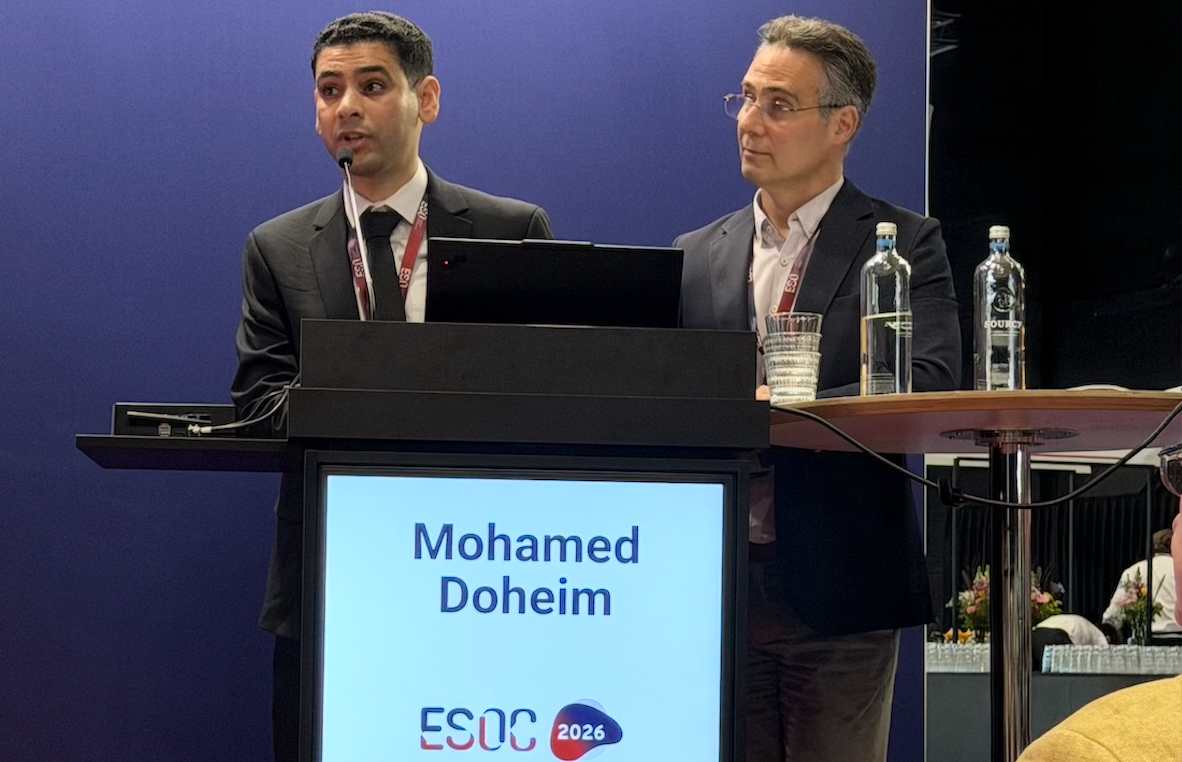
Raul Nogueira and Mo Doheim presenting at the ESOC 2026 Innovation Session
Conference

HORUS on stage at the ESOC Innovation Session

Co-founders Raul G. Nogueira and Mo Doheim presented HORUS at the European Stroke Organisation Conference Innovation Session in Maastricht, making the case for an intelligence layer that delivers guideline-graded decisions in real time.

University of Pittsburgh seal
Licensing

A University of Pittsburgh–licensed company
HORUS executed an exclusive, worldwide software license with the University of Pittsburgh covering LUCID and TrialLens, effective May 26, 2026, moving both validated systems from the research bench toward clinical deployment.

Why it matters

The cost of getting it wrong is rising.

Stroke care that misses the window is increasingly ending up in court. "Time is brain" is now a phrase juries hear, not just a line in the guidelines.

The team

Built by the people who run the code.

Mohamed Doheim, MD, PhD

Mohamed (Mo) Doheim, MD, PhD

Co-Founder & CEO

Clinical Research Assistant Professor of Neurology, Director of the NeuroPrecision Lab, UPMC Stroke Institute.

Raul G. Nogueira, MD, FAHA

Raul G. Nogueira, MD, FAHA

Senior Co-Founder & CMO

Endowed Professor of Neurology and Neurosurgery, Director of the UPMC Stroke Institute, Chief of Cerebrovascular Medicine.

In collaboration with

University of Pittsburgh NeuroPrecision Lab

Get in touch

Join us in rewiring stroke care.

For clinical demonstrations, validation data, or partnership, reach the founding team directly.

horusneurotechnologies@gmail.com
Request a demo